Produced Water
Produced Water Volumes and What Disposal Actually Costs
Water-oil ratios over a well's life, how disposal pricing is actually structured, and the point at which water handling ends a well's economic life.

Where the water comes up from, what is dissolved in it, and the specific reasons it cannot be put on the ground or into a creek.
 By Dale Whitcombe · Field Operations Writer & Founding Editor
· Published
· Last updated
· 5 min read
By Dale Whitcombe · Field Operations Writer & Founding Editor
· Published
· Last updated
· 5 min read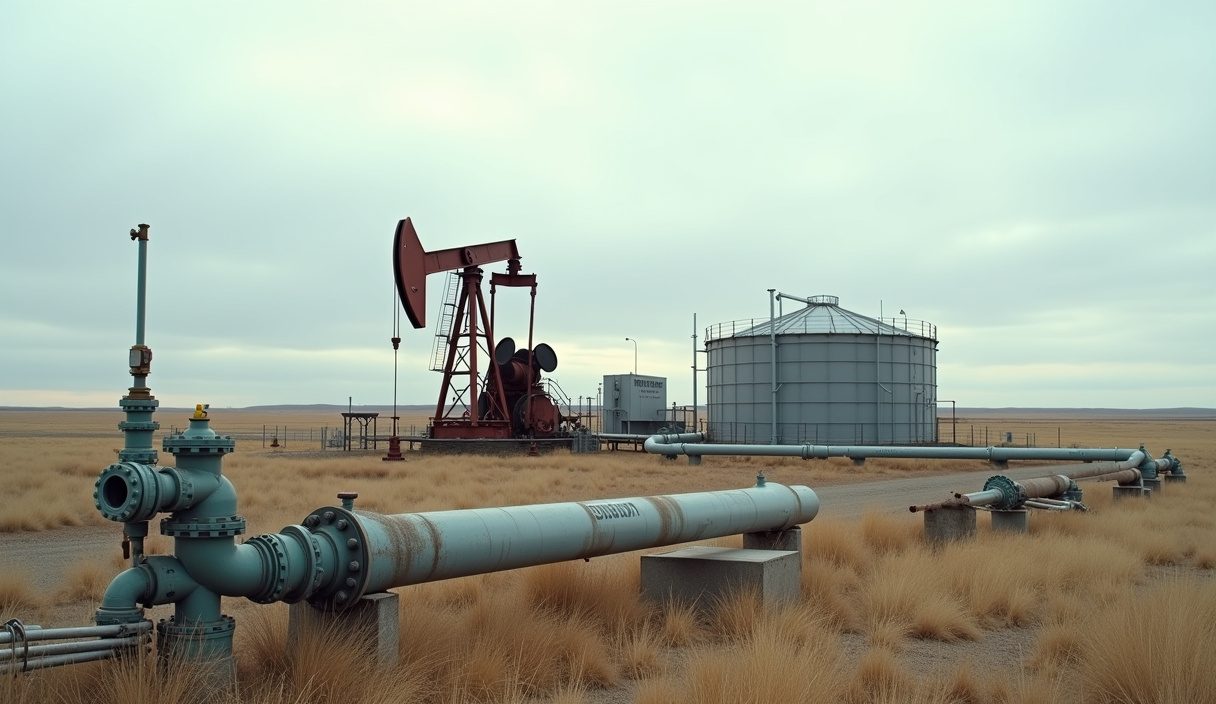
Ask most people what comes out of an oil well and they will say oil, and possibly gas. In Alberta, by volume, the honest answer for a mature well is water. A great deal of water. It is entirely normal for a producing oil well in this province to bring up five to twenty barrels of water for every barrel of oil, and that ratio only climbs as the well ages.
That water is called produced water, and handling it is one of the larger continuing costs of operating a producing property. This guide explains where it comes from, what is in it, and why it cannot simply be discharged.
Produced water has two sources, and in practice a given well is usually making some of each.
Formation water is water that was already in the reservoir rock, held in the pore space alongside the oil and gas. It has been underground for a geologically long time, in contact with rock and hydrocarbons, and it has picked up a great deal of dissolved material along the way. Most produced water in a conventional Alberta oil pool starts out as formation water.
Injected water returning to surface is water that was deliberately pumped into the formation, either to maintain reservoir pressure or to sweep oil toward a producing well, and which has now made its way through the reservoir and back up a producing wellbore. On a waterflood, this becomes the dominant share over time, which is why water cuts on those schemes climb so steeply.
Flowback from a hydraulically fractured well is a related but distinguishable stream: the fracturing fluid returning in the first weeks after a completion. It is usually handled through the same infrastructure but its chemistry is different, because it still carries completion chemicals.
Produced water is not dirty water. It is a chemically complex brine, and the specifics vary enormously between formations, which is why a load from one field can behave quite differently from a load from another.
The salinity alone settles the question. Soil structure collapses when sodium-rich brine is applied to it: clays disperse, the soil loses permeability, and the land stops supporting vegetation. Salt-affected land in southern Alberta can take decades to recover, and in a heavily irrigated agricultural region that is not a tolerable outcome.
Fresh water receiving bodies are equally unsuitable. A brine discharge is acutely toxic to freshwater organisms, and the hydrocarbon content adds a second problem on top of the salt.
Shallow groundwater is the most serious concern of the three. Much of this region relies on shallow aquifers for domestic and stock water, and once saline water enters one, recovery is extremely difficult. This is the single reason that so much of the regulatory framework around produced water is concerned with containment and with verifying that injected fluid stays in the zone it was put into.
So the water goes back underground, into a deep formation well below any usable groundwater, through a licensed disposal well. That is the subject of our disposal well guide.
"Water cut" is the fraction of total produced liquid that is water. A new well in a good pool might start at a low water cut. Over the years it rises, sometimes gradually and sometimes abruptly when water breaks through from an injector or an underlying aquifer.
The economics follow directly. Every barrel of water must be lifted to surface, separated, stored, trucked or piped, and injected, and every one of those steps costs money while producing no revenue. For a well making a modest amount of oil at a 95 per cent water cut, water handling is frequently the largest single operating cost, and it is usually water handling economics rather than reservoir depletion that decides when a marginal well is shut in. Our volumes and costs guide works through the numbers.
Not quite. Flowback is fracturing fluid returning in the weeks after a completion and still carries completion chemicals. Produced water is the longer-term stream, dominated by formation water. They are often handled through the same facilities but they are not interchangeable terms, and some receiving facilities treat them differently.
Yes, and it frequently is, though "reuse" usually means reuse within oilfield operations rather than release. Reinjection for pressure support is the most common. Treating it to a standard fit for agricultural or municipal use is technically possible but the cost is high enough that it is rare in this province. See our treatment guide.
It can contain naturally occurring radioactive material, principally radium, at low concentrations. The practical concern is less the water than the scale and sludge, where NORM concentrates over time. Tank bottoms and scale from some formations require specific handling, and that is a question for your receiving facility and the current AER requirements.
Far more than it produces oil. Provincial volumes run to hundreds of millions of cubic metres a year across conventional and thermal operations. Thermal oil sands recovery in particular is very water-intensive, though much of that water is recycled within the plant rather than disposed of.
For what happens to the water after separation, read the disposal well guide. For the rules governing the whole chain, see our Alberta regulatory guide. This page is general reference and is not a compliance document; verify any requirement against the current AER directives before acting on it.
Water-oil ratios over a well's life, how disposal pricing is actually structured, and the point at which water handling ends a well's economic life.
Separation, skimming, flotation, filtration and chemical treatment: what gets installed on real leases, and which technologies get talked about more than they get built.
What the well classes mean, what each may legally receive, and why the class printed on a facility's approval decides whether your load gets taken.